


Worried About Your Mammogram Result? Let’s Clear the Confusion
You’ve just received your mammogram report… and the words “BI-RADS category 4” are staring back at you.
Your spirits drop.
Thoughts rush through your head: Is this cancer? Do I need an operation? How dangerous is this?
That is precisely what most women find themselves caught between—the dread of the unknown.
But here is the reality: a BI-RADS 4 rating does not mean that you have cancer.
Let’s break it down in a simple, human way—so you understand what’s happening inside your body and what comes next.
What is BI-RADS?
The Breast Imaging Reporting and Data System, also known as BI-RADS, is an organized technique that radiologists use in categorizing imaging studies of the breasts, including:
- Mammogram studies
- USG (Ultrasound)
- MRI studies
Table of Contents
What Each BI-RADS Score Means
- BI-RADS 0: Testing is incomplete, and further evaluation is needed before an accurate score can be assigned.
- BI-RADS 1: A normal result with no signs of lumps, abnormal structures, or calcifications. Continue regular screenings.
- BI-RADS 2: Noncancerous findings are noted (e.g., benign calcifications, unusual lymph nodes). Continue regular screenings.
- BI-RADS 3: Low chance of cancer (2% or less). Follow-up imaging every 6–12 months for at least two years to monitor any changes.
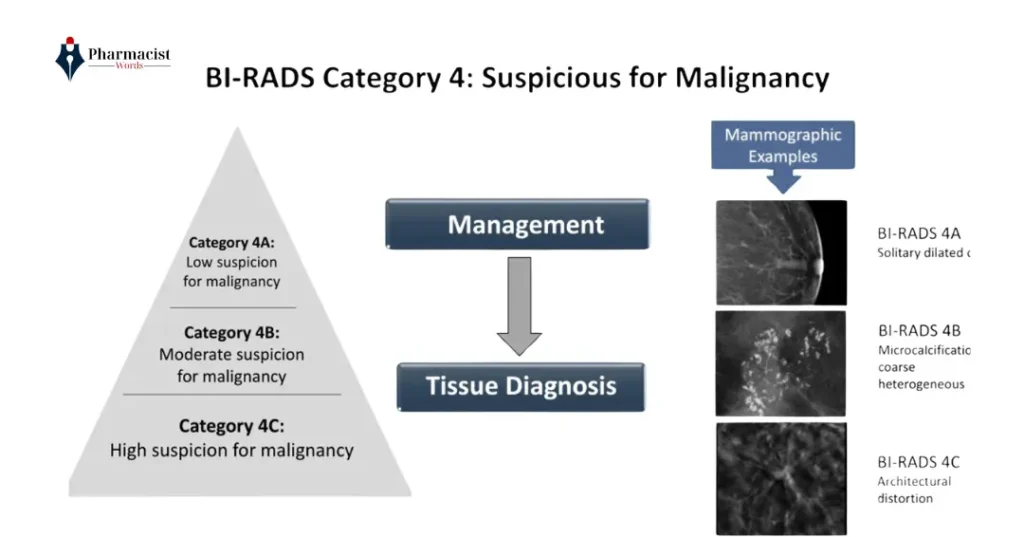
- BI-RADS 4: Suspicious for malignancy, which could be cancer. This comes with its own subcategories, depending on the risk:
- BI-RADS 4A: 2% to 10%
- BI-RADS 4B: 10% to 50%
- BI-RADS 4C: 50% to 95%
A biopsy is recommended.
- BI-RADS 5: Highly suspicious for cancer (95% chance). A biopsy is strongly recommended for a diagnosis.
- BI-RADS 6: Known, biopsy-proven cancer. This score is used for ongoing treatment monitoring. Continue with your treatment plan.
How are BI-RADS Categories Determined?
- Mass: Any abnormality within breast tissues, either benign or malignant.
- Asymmetry: A difference between both breasts, requiring more investigation.
- Architectural Distortions: Changes in breast structure that may be benign or malignant.
- Calcifications: Tiny accumulations of calcium, which are often benign or atypical.
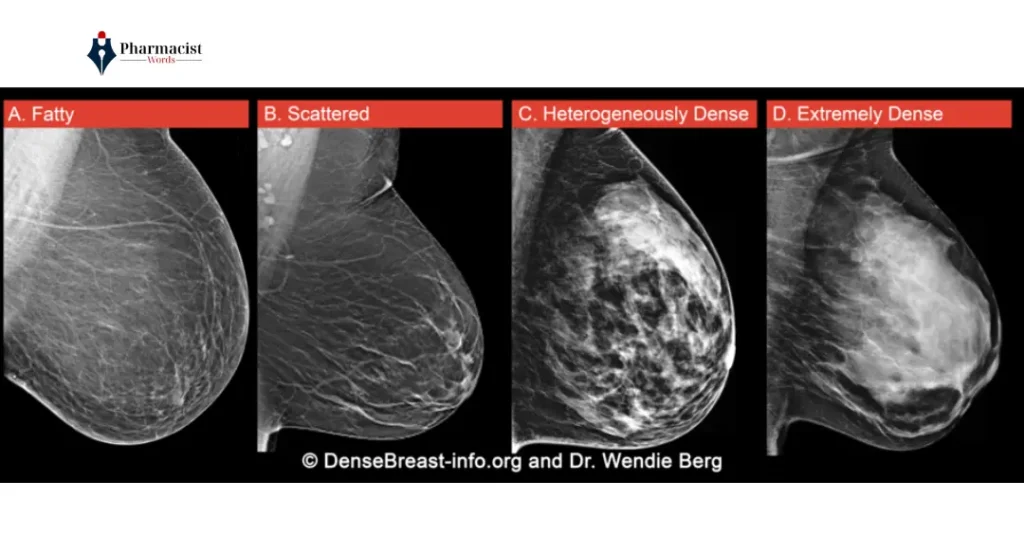
BI-RADS and Breast Density
- Category A (Almost entirely fatty): Mostly fat, making abnormalities easier to detect.
- Category B (Scattered fibroglandular density): There are some dense areas, but they are made up of mostly fatty tissue.
- Category C (Heterogeneously dense): More dense tissue, which can make small masses harder to see.
- Category D (Extremely dense): Mostly dense tissue, which may obscure abnormalities.
Women with Category C or D density have dense breasts, which can make mammogram detection more challenging. About half of the women in the U.S. have dense breasts.
Is BI-RADS 4 Always Cancer?
- Around 60–80% of BI-RADS 4 cases turn out to be non-cancerous
- Only a portion actually confirm cancers after biopsy
So if you’re asking:
“Is BI-RADS 4 always cancer?”
The answer is NO.
Understanding BI-RADS 4 Subcategories (4A, 4B, 4C)
BI-RADS 4A (Low suspicion)
- Cancer risk: ~2–10%
- Often, benign findings like cysts or mild changes
BI-RADS 4B (Moderate suspicion)
- Cancer risk: ~10–50%
- Needs careful evaluation
BI-RADS 4C (High suspicion)
- Cancer risk: ~50–95%
- Closer to BI-RADS 5, but not definitive
What Happens After BI-RADS 4? (Next Steps)
- Biopsy of breast (core needle biopsy/FNAC)
- Further Imaging if needed
- Consultation with Breast specialist
This helps determine if the lesion is benign or malignant
Real-Life Case: Why BI-RADS 3 Appears After Surgery
- Non-cancerous
- Surgically removed
- She experienced breast pain
- Mammography showed BI-RADS 3
Why did this happen?
This is very common and happens due to:
- Post-surgical healing
- Scar tissue formation
- Inflammation
- Fat necrosis (damaged fat tissue)
What does BI-RADS 3 mean here?
- “Probably benign.”
- Cancer risk less than 2%
- Only follow-up imaging needed (no biopsy immediately)
So in this case, the result is reassuring, not alarming
BI-RADS 4 vs BI-RADS 3: Key Difference
At Which Stage Is BI-RADS 4 for Cancer?
This is a prevalent misconception.
BI-RADS doesn’t show cancer stages.
It shows imaging features rather than the stage at which the cancer developed.
Cancer Staging (1-4 Stages) is performed after biopsy results.
How to Treat BI-RADS 4 Diagnosis If It Is Cancer?
If the cancer is confirmed by biopsy,
The treatment will be based on:
- Surgical procedures (lumpectomy or mastectomy)
- Chemotherapy
- Radiation therapy
- Hormone therapy
- The cancer type
- The cancer stage
- The patient's general health conditions
BI-RADS 4&5 Survival Rates Explained
Another prevalent question here is:
“What is the survival rate of BI-RADS 4? “
The Fact Is:
- Because BI-RADS is just an imaging standard
- And the survival rate relies on early detection and the stage
Connection between Menorrhagia and Breast Tissue – Could it Be Hormones?
Most women do not know that there is an underlying connection between menorrhagia and changes in breast tissue that might show up in their imaging reports like BI-RADS.
Hormonal imbalances in your body are not only responsible for causing menstrual disorders such as menorrhagia. They can also play a significant role in breast changes that could include:
- Breast tenderness or pain
- Development of breast cysts
- Altered breast density
- Unusual results in BI-RADS reports
In case you are suffering from menorrhagia, it means that you have increased estrogen levels. This causes the breast tissue to be more susceptible to undergoing benign changes such as cysts or asymmetry. This breast change is visible on a mammogram and results in a BI-RADS assessment of 3 or even 4.
This conclusion does not mean that you have some serious health issues, but it requires further examination.
Main point:
Menstrual cycle and breast condition can be much more interconnected than one might imagine.
Thus, if you face both of these issues simultaneously, you need to speak with your physician concerning hormones.
Tips from Experts on How to Stay Calm and In Control
- Take a deep breath after you see BI-RADS 4: You will be stressed, but keep in mind that it does not necessarily mean that you have cancer.
- Listen to your physician’s advice: They will direct you on how to proceed next, such as going for a biopsy.
- Do not use the Internet to search for the worst-case scenario: It will cause more stress than necessary, and in most cases, things are not that bad.
- Keep your paperwork in order: It will help you keep track of everything.
- Maintain a routine schedule for appointments: Your physician will guide you on how to take care of yourself.
FAQs
1. Is BI-RADS category 4 always cancer?
No. Many cases turn out to be benign after biopsy.
2. What percentage of BI-RADS 4 is cancer?
Ranges from 2% to 95%, depending on subcategory (4A, 4B, 4C).
3. Can BI-RADS 4 go back to normal?
Yes—if the biopsy results are benign, it can be downgraded.
4. Is BI-RADS 3 safer than BI-RADS 4?
Yes. BI-RADS 3 has a very low cancer risk and usually needs only monitoring.
5. Does breast pain mean cancer?
No. Pain is usually linked to hormones, surgery, or inflammation, not cancer.
Final Thoughts: Don’t Let the Number Scare You
Seeing BI-RADS category 4 on your report can feel overwhelming—but it’s not the final answer.
It’s simply a next step marker, guiding doctors to investigate further.
Many women go through this stage and end up with benign results.
The key is: early action, not fear
Don’t neglect a BI-RADS result but also don’t freak out if you or someone you know has received one. See a licensed physician, have the tests that are advised, and keep yourself informed.






One Response
All the best